How Xtreme Energy Drink Conquered Nepal: A Full Marketing Breakdown
In short
Xtreme Energy Drink went from near-zero search interest in 2023 to a Google Trends peak in early 2026 by using every channel at once: shop-level distribution, billboards, cricket sponsorships including the Kathmandu Gorkhas and the national women's team, the T20 World Cup broadcast on Kantipur Max, digital ads, TikTok and community giving. By October 2026 it sponsored 7 of the 8 NPL teams. The lessons: ubiquity, cultural moments and distribution before awareness, plus a growing need for responsible marketing as energy drinks face more scrutiny.
Look at the Google Trends data for “xtreme energy drink” in Nepal over the past five years. For most of 2022 and 2023, the line sits close to zero. Then something shifts. By late 2024, it is climbing. Through 2025, it rises steeply. By early 2026, it hits 100 — the maximum index — a vertical spike that represents peak search interest.
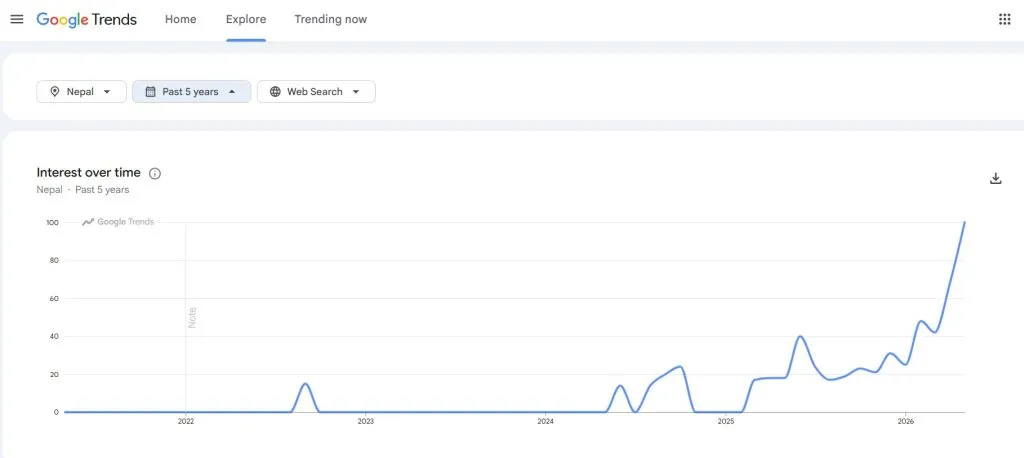
Screenshot of Google Trends for “xtreme energy drink”
That is not organic growth. That is a marketing machine switching on.
Xtreme Energy Drink — produced by Agro Thai Foods in Nepal — has executed one of the most aggressive, multi-channel, multi-touchpoint brand building campaigns Nepal’s FMCG sector has ever seen. From cold stores and tea spots across Kathmandu to the jerseys of Nepal’s national women’s cricket team, from TikTok campaigns to Truecaller ads, from Durbarmarg street festivals to the ICC Men’s T20 World Cup broadcast on national television — Xtreme has been everywhere, all at once.
And it isn’t only a Kathmandu story. Travelling around Nepal, I’ve seen Xtreme billboards and hoarding boards, and the cans on local shop shelves, in most of the districts I’ve passed through — along highways, at bazaar junctions and in towns far from the Valley. Few Nepali brands have put their name in front of so much of the country so quickly.
As a growth strategist, I study brand launches and marketing campaigns in Nepal because they teach things that no international marketing blog ever will. Xtreme’s playbook is a masterclass in how to build a brand in Nepal’s specific market context — and in how import rules can reshape a category and open the door for a local brand.
This is the full breakdown.
“Xtreme did not build a product and wait for the market to find it. It built a presence — in stadiums, on jerseys, in your feed, on your phone, at your local pasal — until refusing to recognise it became impossible.”
Table of Contents
- The Context: Why Nepal Was a Green Field for an Energy Drink Brand
- The Marketing Strategy: Every Channel, Simultaneously
- Layer 1 — Ground-Level Distribution and Visibility
- Layer 2 — Out-of-Home (OOH) and Street Presence
- Layer 3 — Sports Sponsorships: The Core Brand-Building Engine
- Nepal Premier League — Kathmandu Gorkhas Jersey (November 2025)
- National Women’s Cricket Team Jersey Sponsorship (January–February 2026)
- ICC Men’s T20 World Cup Broadcast Sponsorship (January 2026)
- Nepal Road Racing Championship — Xtreme Race (2025)
- Layer 4 — Digital Advertising: Google, Meta, and Truecaller
- Meta Ads (Facebook and Instagram)
- Google Ads
- Truecaller Ads
- Online Khabar and News Media Ad Breaks and Banners
- Layer 5 — TikTok: The Organic Amplifier
- Layer 6 — Community and CSR: Sabitra Bhandari and Flood Relief
- The T20 World Cup Fan Campaign — Consumer Activation Done Right
- Decoding the Xtreme Marketing Playbook
- What Every Nepal Marketer Should Learn From Xtreme
- The Google Trends Signal — What It Actually Means
- Update: What Has Changed Since May 2026
- What Xtreme Has Not Yet Solved
- The Responsible Marketing Question
- The Bigger Marketing Lesson for Nepal Brands
- Checkout services I offer:
- Further Reading
The Context: Why Nepal Was a Green Field for an Energy Drink Brand
To understand why Xtreme’s marketing worked, you first need to understand the market it entered.
The Import Ban — and the Market It Shaped
In June 2019, the Nepal government banned imports of caffeine-mixed energy drinks and flavoured synthetic drinks, citing health concerns and the trade deficit. The ban hit Red Bull, the world’s best-known energy drink. An adviser to Red Bull’s Indian company called it unlawful.
The ban is still in force. Nepal lists it with the WTO as an import prohibition with no end date.
But the ban didn’t take energy drinks out of Nepal. It changed who makes them. Domestic producers moved in, including Xtreme by Agro Thai Foods. And Red Bull adapted too: since December 2023, Red Bull Gold has been made in Nepal by Saras Beverages in Gaidakot.
It is worth being precise about the timeline here. Xtreme’s aggressive marketing surge — the cricket sponsorships, the TikTok campaigns, the digital ads — began in late 2025, roughly six years after the import ban. The Google Trends data confirms this: search interest for “xtreme energy drink” in Nepal was near zero through 2022 and 2023, only beginning to rise meaningfully in late 2024.
So the ban was not the direct trigger for Xtreme’s marketing push, and it did not leave the market empty. Red Bull was on the shelf the whole time. What the ban did was change the rules of the game. Every energy drink sold in Nepal now has to be made in Nepal. That put a local brand like Xtreme on more equal footing with global names on price and availability, and made marketing the deciding factor.
The marketing lesson: Xtreme did not have to convince Nepal that energy drinks were desirable. Years of global Red Bull marketing had already seeded that desire. Xtreme’s challenge was to win that desire for a local brand, against a famous competitor that was still on the shelf. Its answer was to be louder, more local and more present than anyone else. That is a very different marketing problem from building a category from scratch.
The Youth Demographic
Nepal has a young population. The 18–35 age group — the core adult energy drink consumer — is large, digitally active, growing in urban areas, and deeply embedded in sports culture, particularly cricket. This is an audience primed for exactly the kind of brand Xtreme wanted to build: energetic, sport-associated, adventurous, aspirational. The same cricket and social media audience also includes many teenagers, which matters for a product that isn’t meant for children. More on that in the responsible marketing section below.
Google Trends data: Searches for “xtreme energy drink” in Nepal were near zero through 2022 and most of 2023. The curve begins rising in late 2024, accelerates sharply through 2025, and hits the maximum interest index of 100 in early 2026 — coinciding exactly with the T20 World Cup sponsorship and women’s cricket jersey announcement.
The Marketing Strategy: Every Channel, Simultaneously
What separates Xtreme’s approach from most Nepal FMCG brand launches is the sheer breadth and simultaneity of channels. They did not start with one channel, prove it, and expand. They attacked from every direction at once — creating the impression of ubiquity that makes a brand feel established and dominant even when it is relatively new.
Layer 1 — Ground-Level Distribution and Visibility
The foundation of Xtreme’s marketing was not digital. It was physical.
Before any campaign could work, the product had to be visible at every relevant touchpoint where the target consumer spends time. Tea stalls (chiya pasals), cold stores, restaurants, sports venues, and convenience shops across Kathmandu and major cities. A consumer who sees an Xtreme ad on Facebook and then walks into their local pasal and cannot find it is a lost conversion. A consumer who sees the ad and immediately finds the can at the counter completes the loop.
This distribution-first approach is something most digital-native Nepal brands get wrong — they build digital presence before physical availability, then wonder why their campaigns generate awareness without sales. Xtreme understood that in Nepal’s FMCG category, the pasal shelf is the final conversion point. Digital marketing drives you to the shelf. The shelf closes the sale.
Layer 2 — Out-of-Home (OOH) and Street Presence
Xtreme invested significantly in outdoor visibility. Its billboards and hoarding boards aren’t limited to Kathmandu: in my own travels, I’ve seen them in most of the districts I’ve passed through, on highways and in district towns. In the capital, it added event branding on top. The 19th Durbarmarg Street Festival, held on one of Kathmandu’s best-known commercial streets, had Xtreme Energy Drink as its main sponsor.
Events like Durbarmarg Street Festival serve a specific marketing purpose beyond mere exposure. They associate the brand with the energy, excitement, and social atmosphere of a public gathering — exactly the emotional territory an energy drink brand wants to own. You do not just see Xtreme at the festival. You consume Xtreme while you are having fun. That pairing of product with positive experience is the foundation of effective FMCG event marketing.
Layer 3 — Sports Sponsorships: The Core Brand-Building Engine
If Xtreme had a single strategic priority in 2025 and 2026, it was sports. Specifically, cricket — Nepal’s most emotionally invested sport with a rapidly expanding professional ecosystem.
The sponsorship moves were sequenced with impressive strategic logic:
Nepal Premier League — Kathmandu Gorkhas Jersey (November 2025)
Xtreme signed as the official beverage partner of Kathmandu Gorkhas for the NPL season starting November 17, 2025. The Gorkhas’ jersey featured the Xtreme logo on the back throughout the tournament. The signing was covered by The Kathmandu Post, generating earned media alongside the paid sponsorship.
The NPL is Nepal’s premier franchise cricket competition. It is broadcasted on television, covered by national media, discussed on social media, and watched passionately by Nepal’s cricket-loving population. A jersey sponsorship in the NPL is not just brand placement — it is an association with national pride at a moment of high emotional engagement.
National Women’s Cricket Team Jersey Sponsorship (January–February 2026)
Xtreme signed a two-year jersey sponsorship agreement with the Cricket Association of Nepal (CAN) in January 2026 — placing the Xtreme logo on the national women’s cricket team jersey. The new jersey was unveiled at an official ceremony attended by the Acting Member Secretary of the National Sports Council and CAN Secretary Paras Khadka.
This move was strategically significant for multiple reasons. First, the national women’s team operates at an entirely different visibility level than a franchise team — it represents Nepal internationally, carries the national flag, and generates pride-based emotional engagement from a broader demographic than franchise cricket. Second, a two-year commitment signals long-term brand investment rather than a one-time sponsorship of convenience. Third, the association with women’s cricket positions Xtreme as a brand that backs Nepal’s emerging sports talent across genders — an increasingly important brand value for younger Nepali consumers.
ICC Men’s T20 World Cup Broadcast Sponsorship (January 2026)
The most visible Xtreme sponsorship of the entire campaign. Xtreme Energy Drinks became the main sponsor for Kantipur Max HD Television’s live broadcast of the ICC Men’s T20 World Cup — the first time any Nepali television channel had broadcast the tournament live. All 55 matches were broadcast, with English commentary on Kantipur Max and Nepali commentary on Kantipur Max-2.
Pre-match and post-match programmes featuring cricket experts were produced in coordination with Xtreme, embedding the brand into hours of live cricket content. For a Nepal audience that had never watched the T20 World Cup live on national television, this was a historic moment — and Xtreme’s name ran throughout the broadcast.
At the women’s jersey launch, Xtreme also announced that it would distribute 2,000 Nepal cricket team jerseys free of cost at Wankhede Stadium in Mumbai for Nepali supporters travelling to watch Nepal’s T20 World Cup matches live. This activation extended brand presence beyond Nepal’s borders and into the international cricket community.
“Xtreme did not just sponsor cricket. It sponsored Nepal’s cricket moment — the first live T20 World Cup broadcast on a Nepali TV channel. That is not a media buy. That is a permanent place in a cultural memory.”
Nepal Road Racing Championship — Xtreme Race (2025)
Beyond cricket, Xtreme also showed up in motorsports. According to its own Facebook post, it ran an “Xtreme Race” at the Nepal Road Racing Championship 2025. Motorsport fits the brand’s positioning around speed, adrenaline and extreme performance, and race footage makes natural short-form video content.
Layer 4 — Digital Advertising: Google, Meta, and Truecaller
Alongside its sports and OOH presence, Xtreme ran aggressive digital advertising across multiple platforms simultaneously.
Meta Ads (Facebook and Instagram)
Xtreme ran Facebook and Instagram ads with energy, adventure and sports-themed creative. They ran alongside organic content from its events and cricket partnerships, so paid reach and organic engagement reinforced each other.
Google Ads
Xtreme’s banner ads appear on websites across Google’s Display Network. Display ads reach people before they search. They build awareness and recall, but they don’t capture search intent. That is the job of Search ads. As search interest in “xtreme energy drink” grew through 2025, the natural next step for any brand in this position is to pair Display with Google Search ads on its own brand name, so it shows up at the exact moment people look for it.
Truecaller Ads
One of the more distinctive digital choices in Xtreme’s mix. Truecaller — the caller ID and spam detection app — is one of the most widely used apps in Nepal, where it is used to identify unknown callers. Truecaller ads run on the after-call screen and, in markets where Truecaller has rolled it out since 2025, on the caller ID screen while the phone is ringing. Both are moments when the user is looking straight at their phone. It is an unconventional placement but a smart one for a brand trying to reach mobile-first Nepali consumers.
Online Khabar and News Media Ad Breaks and Banners
Xtreme placed video ads in the ad breaks of Online Khabar — one of Nepal’s most widely read digital news platforms, known particularly for its video news content. This placement was strategically intelligent: Online Khabar’s audience skews toward urban, digitally active Nepali adults who consume news online rather than through traditional television. Running ad breaks in video news content puts Xtreme in the same viewing session as content that already has the audience’s full attention. Beside Online Khabar, Xtreme banner ads can be seen on various other digital news media websites.
Layer 5 — TikTok: The Organic Amplifier
Xtreme’s TikTok strategy deserves specific attention because it operated differently from its paid digital channels. While Meta and Google Ads were paid reach plays, TikTok functioned as an organic content and community engine.
In April 2026, the brand ran a TikTok challenge tied to the IPL, covered by eKantipur’s market section. Entrants made videos to Xtreme’s brand song, “Water le pugdaina hai… Xtreme nai chahinchha” (“Water isn’t enough… you need Xtreme”). Daily winners were shown on Kantipur Max’s IPL pre-match show, and one winner each week got a four-day trip to watch the IPL in India. It is a smart loop: user videos feed the TikTok algorithm, and the TV show rewards the best ones in front of a cricket audience.
Xtreme also promoted a Kathmandu Gorkhas talent hunt — “Picking up Xtreme talents from all over Nepal” — which brought in content from cricket fans across the country. Content from real participants is more credible than branded content, and it costs a fraction of equivalent paid reach.
Layer 6 — Community and CSR: Sabitra Bhandari and Flood Relief
In February 2026, Xtreme pledged NPR 5 lakh toward the knee surgery of Sabitra Bhandari “Samba”, captain of Nepal’s women’s national football team. She had started a public fundraiser, saying the football association had not followed through on support for her treatment. Xtreme was one of several companies that stepped in, alongside brands like CG and Dove.
In August 2026, Xtreme also gave NPR 1 crore for flood relief, handed over for the Prime Minister’s relief fund.
Support like this builds real goodwill. But it should be seen for what it is: help for people in need, not a marketing tactic. A brand that turns someone’s hardship into an advert risks losing the very trust it hoped to earn. The better approach is to give, let the news speak for itself, and respect the dignity of the person being helped.
The T20 World Cup Fan Campaign — Consumer Activation Done Right
One of Xtreme’s most complete campaign executions was the T20 World Cup Fan Scheme announced in January 2026, run jointly with sibling brand Max Tiger Energy Drink under parent company Agro Thai Foods.
The mechanics were elegantly simple: purchase Xtreme or Max Tiger Energy Drink, post a photo or video on Facebook or Instagram using the campaign hashtags (#T20XtremeEnergydrink), and enter to win a four-day trip to Mumbai to watch Nepal play in the T20 World Cup live at Wankhede Stadium.
40 total winners were selected — 15 through events organised in 15 major cities across Nepal (physical activation with national reach), and 25 through social media participation (digital activation with national reach). The prize — watching Nepal play cricket internationally — was perfectly aligned with the heightened national pride around Nepal’s T20 World Cup participation.
This campaign achieved multiple marketing objectives simultaneously:
-
Sales activation: Purchase required to enter — directly tied to product trial and repeat purchase
-
Social proof generation: Consumers posting with brand hashtags created an organic content wave across Facebook and Instagram
-
Brand association: The prize tied Xtreme permanently to Nepal’s T20 World Cup moment in participants’ memories
-
National reach: 15-city physical events ensured the campaign reached beyond Kathmandu into smaller urban markets
-
User-generated content: Consumer posts provided authentic, high-volume branded content at zero content production cost
One caution for anyone copying this: purchase-linked draws need clear terms, a published list of winners, and pricing that doesn’t quietly include the cost of the prizes. Nepal’s Consumer Protection Act bans misleading promotion and unfair trade practices, so check the rules before you run one.
Xtreme did not stop at cricket. With the FIFA World Cup 2026 approaching, the brand launched another consumer activation campaign — this time tying their product directly to football fever. The “Scan Ma Sun” (Scan for Gold) campaign, covered by Online Khabar, invited customers to scan a QR code on the Xtreme can, register their details, and enter a lucky draw for a solid gold football — a “sunko ball”. It ran from mid-May through the FIFA World Cup 2026. In August 2026, Xtreme awarded three gold balls of 3.5 tola each and said more than 1.2 lakh people had taken part.
The mechanics are deliberately simple and deeply tied to the purchase moment — the QR code is on the can itself, so buying a can gives customers an instant reason to engage digitally. It is a textbook purchase-to-digital activation: the physical product becomes the entry point to a digital campaign, generating consumer data, app or social media engagement, and brand association with the world’s biggest sporting event simultaneously. And the prize — a golden ball during the Football World Cup — is one of those ideas that is so on-brand and so culturally resonant that it generates its own organic social sharing.
Decoding the Xtreme Marketing Playbook
Stepping back from the individual activations, the coherent strategic logic of Xtreme’s approach becomes clear. Every element maps to one of four objectives:
| Marketing Layer | Strategic Objective | Nepal-Specific Rationale |
|---|---|---|
| Distribution (pasals, cold stores, restaurants) | Availability and trial | In Nepal’s FMCG market, the pasal shelf is the final conversion point. Digital drives to shelf. Shelf closes the sale. |
| Sports sponsorships (NPL, national team, T20 WC) | Brand association and emotional equity | Cricket is Nepal’s highest-engagement sport. Association with cricket = association with national pride. |
| OOH and events (Durbarmarg, motorsports, new year events) | Physical presence and brand recall | High-footfall events create product-fun pairing. OOH creates frequency and recall in Nepal’s urban centres. |
| Digital (Meta, Google, Truecaller, Online Khabar) | Targeted reach and intent capture | Multi-platform digital ensures brand reaches Nepal’s mobile-first youth across every digital touchpoint. |
| TikTok (organic + UGC campaigns) | Community building and content amplification | TikTok’s algorithm gives Nepali brands extraordinary organic reach among under-30 audiences at near-zero cost. |
| CSR (support for Sabitra Bhandari, flood relief) | Trust and community goodwill | Nepali consumers respect brands that show up for the community. Done sincerely, giving builds goodwill. Treated as a tactic, it backfires. |
| Consumer activation (T20 fan scheme) | Purchase incentive and social proof generation | Purchase-tied campaigns drive trial while UGC creates social proof at scale. |
What Every Nepal Marketer Should Learn From Xtreme
1. Ubiquity is a strategy
Xtreme did not choose between sports sponsorship and digital ads or between OOH and social media. It ran all of them simultaneously. The psychological impact of seeing a brand across multiple unrelated contexts — on the cricket jersey, on your Facebook feed, on a billboard on Durbar Marg, in the Truecaller screen when your phone rings — creates a perception of market dominance that any single channel cannot produce. In Nepal’s market, where brand loyalty is still being established across many categories, ubiquity is a form of authority.
Pushkar Sharma, one of Nepal’s well-known marketing voices, put it precisely in a Facebook video when observing Xtreme’s campaign: “Xtreme Energy Drink has taken this seriously — be in the mind and be easy to find.”
That single sentence captures the entire dual mandate of FMCG brand building. Be in the mind is the awareness job — sports sponsorships, TikTok content, digital ads, OOH, news media placements. Be easy to find is the distribution job — the pasal shelf, the cold store counter, the restaurant fridge. Xtreme worked both levers at the same time. Most Nepal brands work only one — and wonder why the other is not producing results.
2. Find the cultural moment and own it
The T20 World Cup broadcast was the first time a Nepali TV channel showed the tournament live. That was a cultural moment — the kind that gets remembered, talked about, and associated with brands for years. Xtreme was the main sponsor. When Nepali cricket fans remember watching their team at the World Cup live on a Nepali channel for the first time, they will remember Xtreme. That is brand equity that no amount of product advertising can buy.
3. The regulatory landscape shapes your market — understand it
The 2019 import ban did not cause Xtreme’s rise — the timeline does not support that. And it did not remove Red Bull, which now makes its drink in Nepal. But it did change the rules of the game: every energy drink on the shelf now has to be made locally.
Regulation can also move against you. In the 2083/84 budget, excise duty on energy drinks rose from Rs 52 to Rs 120 per litre. Any Nepal FMCG or consumer brand should map these forces — import rules, taxes, labelling and advertising law — before building its go-to-market strategy.
4. Distribution before awareness
Building awareness for a product that people cannot find is one of the most expensive mistakes in FMCG marketing. Xtreme built its distribution network — pasals, cold stores, restaurants — before or alongside its awareness campaigns. The consumer who sees the ad and finds the can at the counter converts. The consumer who sees the ad and cannot find the product becomes frustrated and forgets. Distribution is marketing infrastructure, not just a supply chain function.
5. TikTok is Nepal’s most underused brand-building tool
Xtreme’s TikTok presence — combining organic adventure content, event coverage, and UGC campaigns — demonstrates what the platform can do for Nepal consumer brands. The algorithm’s willingness to show content from new accounts to large audiences is a structural advantage few other platforms offer in Nepal. The brands that build genuine TikTok communities now will be very difficult to displace later. One caveat: TikTok’s audience skews young, so brands selling products not meant for children need to be careful about who they target.
6. Community investment builds trust that advertising cannot buy
Xtreme’s support for Sabitra Bhandari and its flood relief contribution show a brand that is willing to show up for the community. Nepali consumers have a strong collective identity, and they notice who helps. That goodwill lasts longer than any campaign — as long as the giving is genuine and never turned into an advert.
The Google Trends Signal — What It Actually Means
Return to that Google Trends chart for a moment (as of May 2026). The steep rise from near-zero to index 100 between 2024 and early 2026 is not just evidence that more people are searching for Xtreme. It is evidence that the marketing campaign worked.
Search interest is a lagging indicator of brand awareness. People do not search for brands they do not know exist. The rising search curve means that Xtreme’s multi-channel marketing campaign — the cricket sponsorships, the TikTok campaigns, the billboard presence, the digital ads — successfully drove awareness at scale into a population that had little prior exposure to the brand.
The spike in early 2026 — coinciding with the T20 World Cup broadcast, the women’s team jersey announcement, and the fan scheme campaign — is the visible signature of a marketing machine firing on all cylinders simultaneously.
Update: What Has Changed Since May 2026
Xtreme hasn’t slowed down. Here’s what has happened since this case study was first published.
The T20 World Cup. Nepal played all its group matches at Wankhede Stadium in Mumbai. It lost to England by just 4 runs, beat Scotland by seven wickets, and went out in the group stage. The close game against England kept the whole country watching, which is exactly the moment Xtreme had paid to be part of.
Bigger in cricket.
- In July 2026, Xtreme signed a new three-year deal with Kathmandu Gorkhas, moving its logo to the front of the jersey as main sponsor.
- It became the arm sponsor of Nepal’s men’s national and A teams.
- For NPL Season 3 (26 October to 21 November 2026), Xtreme sponsors seven of the eight teams and built branded team gates at the TU ground.
Beyond cricket. Xtreme became title sponsor of the first Nepal Volleyball League on a three-year deal, backed a PUBG Mobile national esports competition, and is the main sponsor of Virat Expo 2026 in Biratnagar.
Into music. On 10 October 2026, Xtreme launched the Xtreme Music Series, a season of original songs and music videos from nine emerging Nepali artists, with a new release every two weeks on its YouTube channel. It is the brand’s first big step outside sport, and a way to build content that people choose to watch, not just logos they see.
More competition. Red Bull is made locally and expanding. In May 2026, CG Reliance launched Campa Energy Gold Boost at NPR 80. PepsiCo’s Sting is also on the shelf.
Higher taxes. Excise duty on energy drinks more than doubled in the 2083/84 budget.
What it means. Sponsoring seven of eight NPL teams is close to owning the league’s look. The ubiquity playbook is still running at full speed. But with more competition, higher taxes and growing public debate about energy drinks, the next phase will test whether all that visibility turns into lasting loyalty.
What Xtreme Has Not Yet Solved
A fair analysis acknowledges the limitations alongside the strengths.
Awareness and availability are no longer the problem. Xtreme’s billboards and its shelf presence now reach well beyond the Valley. The harder question is loyalty. With Red Bull made locally, Campa and Sting on the same shelves and higher excise pushing prices up, will people keep choosing Xtreme once the sponsorship buzz settles? Reach can be bought. Repeat buying has to be earned.
Brand association through sports sponsorship is powerful but expensive and non-compounding. Jersey logos and broadcast sponsorships are rented visibility — when the contract ends, the visibility ends. Xtreme will need to build the kind of organic brand community — through content, loyalty programmes, and consistent product experience — that continues to compound after any individual sponsorship expires.
The energy drink category in Nepal also carries health perception challenges. As Nepal’s urban consumer base becomes more health-conscious, the brand’s “Energizes Body and Mind” claim will need to evolve or be complemented by messaging around product quality, ingredients, and responsible consumption — a challenge Red Bull navigated globally over two decades.
The Responsible Marketing Question
There’s one more challenge that has grown since this case study was first written. It affects the whole category, not just Xtreme.
The debate has started in Nepal. In June 2026, the Himalaya Times ran a piece titled “Energy or Illusion?”, questioning the caffeine and sugar in energy drinks and the marketing aimed at young people. The same paper later reported that a Nepal Consumer Forum leader called for limits on energy drink ads aimed at youth.
Nepal’s rules are still light. Based on that reporting, Nepal has no caffeine limit and no minimum age for buying energy drinks. Xtreme’s tactics are not illegal. But “legal” and “safe for the brand” are not the same thing.
The rest of the world is moving.
- The WHO recommends restricting the marketing of high-sugar foods and drinks to all children under 18.
- England plans to ban sales of high-caffeine energy drinks to under-16s from April 2027, subject to Parliament’s approval.
- Europe’s food safety agency advises that teenagers keep caffeine to about 3 mg per kg of body weight a day. For a 40 kg teenager, that’s around 120 mg.
Why this matters for marketers. Cricket, TikTok and esports audiences include a lot of teenagers. A brand that reaches them heavily is building on ground that could shift under its feet. One new rule, or one viral backlash, could undo years of sponsorship spend.
The smart move is to set your own guardrails before anyone forces you to:
- Target adults in paid media.
- Keep school-age audiences out of giveaways and contests.
- Show caffeine content and warnings clearly on the pack and in ads.
- Avoid health claims you can’t prove.
That isn’t just ethics. It’s how a fast-growing brand protects everything it has built.
This section is a marketing perspective, not legal advice.
The Bigger Marketing Lesson for Nepal Brands
Xtreme’s story is not really about energy drinks. It is about what happens when a Nepal brand takes marketing seriously — building a multi-channel strategy, investing in cultural moments, combining physical and digital presence, and committing to consistent brand positioning across every touchpoint.
Most Nepal brands are still doing one thing — posting on Facebook, or running a single billboard, or doing a one-time influencer campaign — and then wondering why the needle doesn’t move. Xtreme did everything at once. It accepted that brand building is expensive and compounding — that the first NPL sponsorship makes the women’s team jersey sponsorship more valuable, which makes the T20 World Cup broadcast sponsorship more valuable, which makes the next activation even more valuable.
That is what a real brand marketing system looks like.
Building a brand in Nepal and want to think through your marketing strategy?
I work with Nepal businesses and startups to build full-funnel marketing strategies — from positioning and channel selection to campaign execution and measurement. If you want to think through what Xtreme did and how to apply it to your own brand, let’s talk.
Talk to Bimal about your marketing strategy
Checkout services I offer:
Further Reading
-
Go-to-Market Strategy for Nepali Startups: The Complete Founder’s Playbook
-
App Growth Strategy for Nepal — How to Get Your First 10,000 Downloads
More in Case Study
View all →September 8, 2026
How Nepal's PM Sold Cheese in 24 Hours (And Why It Didn't Last)
PM Balen Shah's yak cheese post went viral and sales jumped 30% overnight. Here's what actually happened, why it faded fast, and what Nepal brands should learn from it.
March 30, 2026
Decoding Khalti: Story Behind the Explosive Growth of Nepal's Fintech Giant
Explore the data-backed growth of Khalti Digital Wallet. From its scrappy 2017 launch and viral referral loops to the historic merger with IME Pay.
March 27, 2026
How Trip Turbo Became Nepal’s #1 Travel App | 500k+ Downloads
From a 2-person marketing team to 500,000+ downloads. Discover the growth story behind Trip Turbo, Nepal's largest travel marketplace and #1 travel app.